The Smartest Way to Get Strangers Onto Your Property: Movie Nights
Some cities you visit. Others you come back to.
San Diego is the second kind for me. The plane touches down, the air hits my face, and something in me exhales. I'm home, even though I'm not.
This trip, I didn't have much of a plan. Which is usually when the best ideas show up.
I was browsing things to do (San Diego never runs short) when I found out that La Valencia Hotel in La Jolla shows movies under the stars. I've been going to La Valencia for years. Somehow I'd missed this.
Outdoor cinema isn't a new idea, of course.
One of my favorite memories in this city is the rooftop of the Hyatt downtown, where Rooftop Cinema Club used to play old classics against the skyline. They've since packed up and moved to the Porto Vista Hotel in Little Italy.
So now I was curious. How many hotels are doing this?
More than I expected.
The Hyatt Regency Mission Bay sets up a screen right beside the pool. I picked up the phone to ask what they show. Mostly family films, the kind you can bring a six-year-old to.
And you don't need a pool at all. Hotel del Coronado puts the screen on the beach and lets people sink their toes in the sand. Over in the Gaslamp Quarter, the Hilton runs themed nights, like a Ghostbusters screening for Halloween.
I even found one hotel that offers this experience through a ResortPass app.
I set out looking for something to do on a Saturday. I ended up with a business model.
Why it works
A movie night is a front door. People who would never book a room at your property will happily buy a ticket to watch a film they already love. You're borrowing that love. The experience is halfway to great before the opening credits.
Then they're on your grounds. They see the lawn, the bar, the lighting, the staff. They get a feel for the place without committing to a night's stay. Some of them will come back. Some will tell a friend.
And every one of them has a phone. A glowing screen under the stars is made for Instagram.
The math
Let's keep it simple and imagine 100 seats. Not every night sells out, so let's assume 75% occupancy. That's 75 movie-guests.
Tickets in San Diego run about $25 per person. That's $1,875 per movie-night.
Food and drinks come next. Some hotels serve from their own kitchen. Others wheel out a little kiosk with popcorn and drinks for the night. If half the guests spend $20, that's another $750. That's a very conservative take btw.
Then the blankets. When I went to the Hyatt rooftop, it was winter and I was freezing. They were selling throws for about $20. They looked like something you'd get on a red-eye flight. I didn't care. I bought one. If about 1 in 10 guests does the same, that's roughly $150.
One night, about $2,775.
Most hotels run one screening a week, usually a weekend night. Some add a second, like Wednesday or Friday. Plan for a few weather cancellations. Even in San Diego, 48 good nights a year is more realistic than 52. At one screening a week, that's about $11,100 a month and around $133,000 a year. Colder markets will want to plan a shorter season.
The lineup depends on the crowd. Some hotels stick to cartoons and family picks. Others go nostalgic with Fight Club, Pretty Woman, and The Godfather.
What it costs
Hotels mostly use what's already there.
A lawn. A pool deck. A beach, if you're lucky enough to be the Hotel del. They pull chairs from their event storage and set out a few high-top tables for people who like to mingle before the movie starts.
You don't need a big team either. Two people can handle it: one welcomes guests and hands out headphones, one runs the kiosk, and both clean up at the end. A third person makes the night feel effortless. Rooftop Cinema Club seems to staff with students and interns for the season. Budget about $25 an hour per person once you add payroll taxes.
Per night, the costs look something like this:
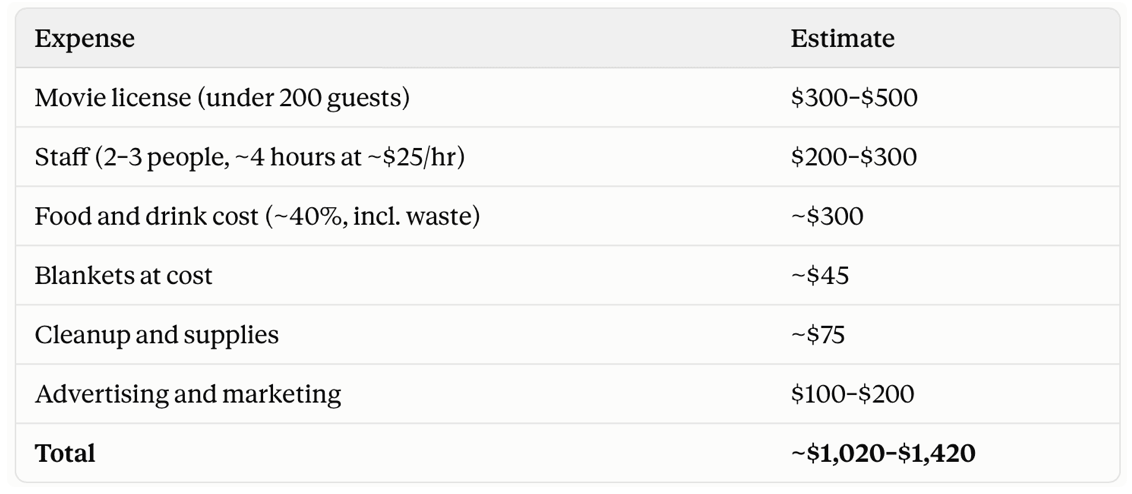
Not included: card and ticketing fees (usually around 3% of sales), insurance, and any local permits. Check with your city before the first screening.
Food cost runs higher than you'd think. You stock more than you sell. Leftover popcorn gets tossed, opened wine doesn't keep, and cups and napkins add up. I think budgeting 40% keeps the numbers honest.
Then there's marketing. Your hotel guests will find the movie night on their own. Locals won't. A few boosted Instagram posts/meta ad campaigns, a listing on local event sites, and some table cards at the bar go a long way. Budget $100 to $200 a night. Once the series builds a following, you can pull that back.
One thing people forget: the license. A Netflix account or a DVD won't cover a paying audience. You need a public performance license, usually from Swank Motion Pictures or Criterion Pictures. If you're selling tickets, ask them early whether it's a flat fee or a share of sales. That single answer can reshape your margins.
The upfront investment
Rough estimate on a napkin:
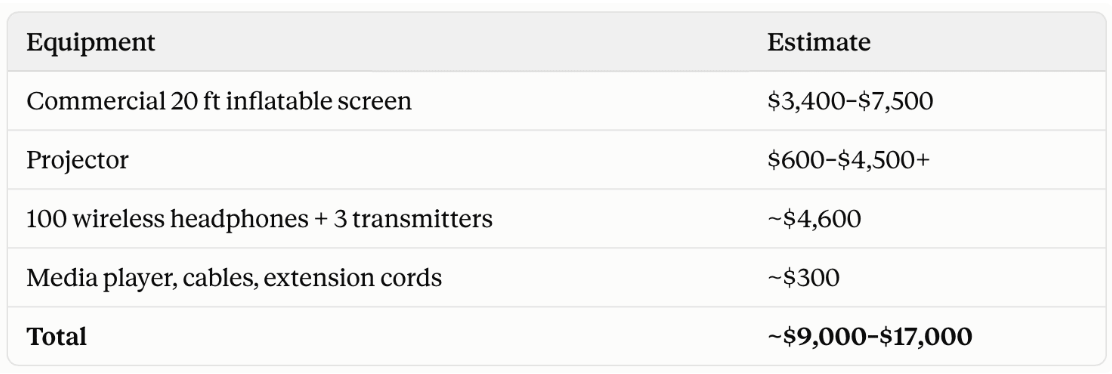
You'll find 20 ft inflatable screens online for under $150. Great for a backyard. For a weekly event with paying guests, spend more. Commercial screens stand up to wind and last for years.
The headphones are the hero here. Everyone gets clear sound, and the rest of the property stays peaceful. The couple trying to sleep in room 214 will never know a movie is playing.
At about $1,550 net per night, the equipment pays for itself in six to eleven screenings.
The full year
Here's what 48 movie nights look like at 75% occupancy. I used the middle of each cost range.
Let me know if you think I am waaaay off on some lines!
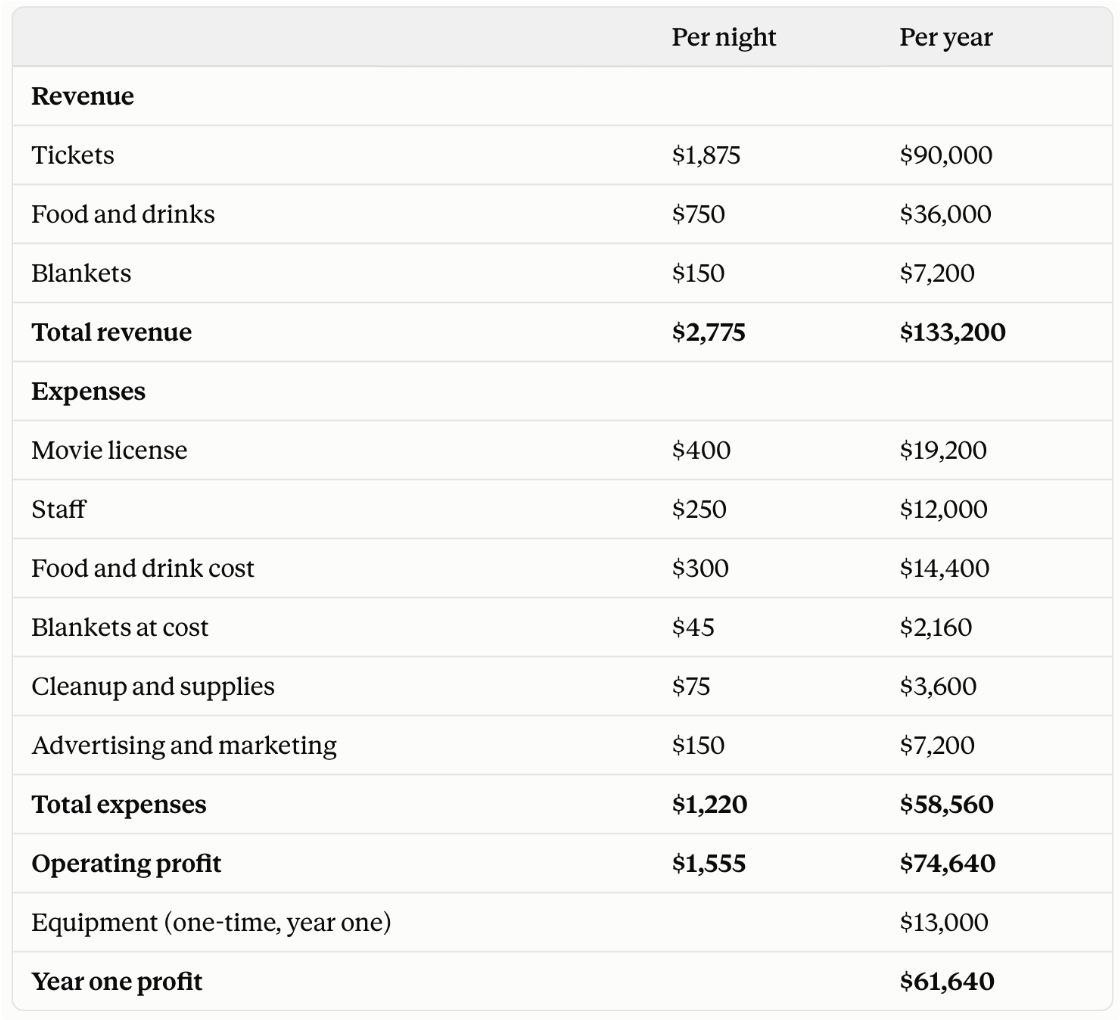
From year two on, the equipment is paid for. Profit goes back to about $75,000, minus the occasional repair or replacement headphones. Sell out more nights, and every extra seat drops almost straight to the bottom line.
Not just for hotels
Lately I've been noticing outdoor screens show up in Airbnb listings too, often right beside the pool.
For a rental, a screen gives guests a private movie night without ever leaving the property. It's the kind of small magic that ends up in a five-star review.
It's also a hero shot. Picture a lit pool, a glowing screen, a few loungers, and the last color fading from the sky. That photo sells the stay.
The setup is simple: a budget inflatable screen, a decent projector, and a Bluetooth speaker. As long as it's a private screening for your guests, you don't need a license, to my knowledge.
If you're building a micro-resort
You don't need 100 seats to make this work. A 20-cabin property can host 30 people on a lawn with a screen, a projector, and a fire pit.
Start with your own guests. Then open a handful of seats to locals. Once you sell seats to outsiders, you'll need a public performance license, same as the hotels.
You'll have created a marketing channel, a community event, and a new revenue line, all in one evening.
I came to San Diego to rest. I'm walking away with a notebook full of ideas.
Grateful for this city, every single time.
That's all for today,
Till next week, dear readers.
p.s. if you're in San Diego and want to meet up, let me know.